CLASS 9 · SETS
Venn Diagram — Word Problems
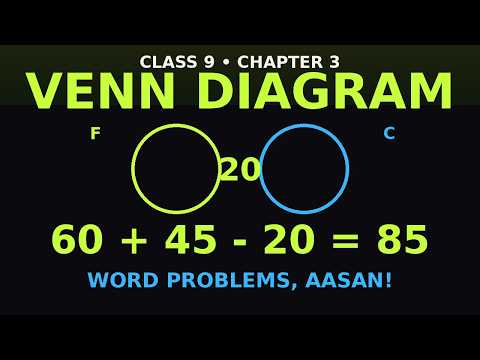
Do sets ke word problems Venn diagram bana kar hal karna — 60 + 45 − 20 wala mashhoor tareeqa, poori video mein step by step.
BSEK • Karachi Board
Notes, formulas and solved question types for Class 9 — explained step by step, in the order you actually write them in your paper.
Main Video — Venn Diagram — Class 9
Har dafa page khulne par teen long videos mein se koi ek yahi, isi page par khud chalti hai — website se bahar nahi jati. Shuru mein awaaz band (mute) hoti hai; player ke andar speaker wale button se awaaz kholo, ya upar wale button se video sound ke saath yahi dobara chalao.
Teen mukammal LONG videos — theorems tafseel se. Kisi card par click karo — video yahi, isi page ke andar chal jayegi, website se bahar nahi jayegi. Baaki saari videos ke liye neeche YouTube channel ka button hai.
Do sets ke word problems Venn diagram bana kar hal karna — 60 + 45 − 20 wala mashhoor tareeqa, poori video mein step by step.
Side-Angle-Side se do triangles ke congruent hone ki proof — Given, To Prove, Construction aur Proof, har line ki wajah ke saath.
Class 9 Physics ke Chapter 2 ki mukammal long video — poora chapter tafseel se samjhaya gaya hai.
One focused type per day. First understand the method, then solve the same pattern without looking.
Product, division, powers and roots — with characteristic and mantissa.
Factor each polynomial first, then compare common and highest powers.
Recognise a³ ± b³ and write the correct sign pattern without guessing.
Use coordinates to prove a figure is a square or rectangle.
Construction steps, clean diagram and reasons in exam order.
Given, to prove, construction and proof — each line with its reason.
Keep quantities in the same units, form the proportion, then solve the unknown.
Short, exact definitions from matrices, logarithms and coordinate geometry.
Factorization, completing the square and the quadratic formula.
Reduce one side at a time and keep identities visible.
State the theorem before using it in the proof.
Organise the data first, then calculate each measure with its complete working.
Open the source paper, try it under exam timing, then compare your method with the worked pattern below.
75 marks with MCQ, short-answer and descriptive sections for regular and private candidates.
Paper Kholo (PDF)A complete board-format paper for timed practice. Mark difficult questions for the next revision round.
Paper Kholo (PDF)Using logarithms, evaluate 25.753 ÷ 0.5341. Round to the accuracy supported by a four-figure table.
Worked from the BSEK Class 9 model paper (2022) — Paper Kholo. Paper pehle khulega, phir wahan se download kar lena.
Asal purane board papers ke verified links. Har card par class, subject, saal aur medium saaf likha hai — har link nayi tab mein khulega.
Karachi Board ka 2024 ka asal paper, English medium — Tayarri par poora paper online, wahan se Download button se download karo.
Paper KholoWohi 2024 ka paper Urdu medium mein — Tayarri par poora paper online, wahan se Download button se download karo.
Paper KholoIlmkidunya par Class 9 Karachi Board ke past papers — Maths 2025, 2024 aur baqi tamam subjects.
Papers DekhoIlmkidunya par Class 9 Maths ke past papers aur model paper — pehle poora paper kholo, phir wahan se download karo.
Papers DekhoIlmkidunya par Karachi Board Class 10 ke tamam subjects ke past papers — Maths ke ilawa baqi subjects bhi.
Papers DekhoIlmkidunya par Class 9 ke model papers — Sindh / Karachi Board samait — paper pattern samajhne ke liye best.
Model Papers DekhoCard par click karo — pehle poora paper khulega, phir wahan se Download kar lena.
Short revision on the left. Quick formula recall on the right. Use both before a timed attempt.
Never jump from question to answer. A clean method can earn marks even when the last number goes wrong.
Card par tap karo to woh palat jayega — peeche jawab aur ek board tip milega. Pehle zehen mein jawab socho, phir palat kar check karo. Pehle Maths ka deck tayyar hai; Chemistry aur Physics usi tartib mein baad mein ayenge.
Maths ka deck pehle mukammal hoga, phir Chemistry ka deck bilkul isi andaaz mein yahin add hoga — Class 9 aur 10 ke board chapters ke hisaab se. Filhal ye topics line mein hain:
Tartib wohi rahegi jo tay hui hai: pehle Maths, phir Chemistry, phir Physics. Physics deck mein definitions, formulas aur numericals ke chhote cards honge. Filhal ye topics line mein hain:
Apna maths sawal box mein likho — poora hal step by step yahin ban jayega, bilkul copy wale andaaz mein: har step ke saath us ki wajah. Square ke liye x^2 ya x², dono chalega.
In types ke sawal hal hote hain: linear equations · quadratic equations · simultaneous equations (do equations ke darmiyan ; lagao) · percentage · ratio & proportion · HCF / LCM · factorisation · brackets expand · simplify. Jo type abhi supported nahi, us ke liye neeche Secret Websites wala section hai.
Ye paanch websites har maths student ko pata honi chahiye — sawal likho, step-by-step hal aur graph foran mil jata hai. Board ki tayyari mein seedha kaam aati hain.
Bina login kiye algebra se calculus tak har sawal ka step-by-step hal.
cymath.comAdvanced maths, limits, formulas ke graphs aur derivations.
symbolab.comGeometry aur graphs ko visual bana kar samajhna — shapes khud bana kar dekho ke theorem kaam kese karta hai.
geogebra.orgFree graphing calculator — functions ko live graph par dekho aur sliders se values badal kar result samjho.
desmos.comMushkil sawalon ke jawab aur step-by-step solutions — equation dalo, poora hal with steps mil jata hai.
wolframalpha.comChhote roz-marra ke hisaab — percentage, average, fractions aur marks — numbers likho, jawab foran yahin mil jayega. Koi sign-up nahi, sab browser mein chalta hai.
Kisi number ka percentage nikalo, ya dekho ek number doosre ka kitna percent hai.
KITNA PERCENT HAI? · WHAT IS …% OF …?
PERCENT KITNA BANTA HAI? · … IS WHAT % OF …?
Numbers comma laga kar likho — mean, median aur mode teeno ek saath mil jayenge.
NUMBERS LIKHO · SEPARATE WITH COMMAS
Do fractions ko add, subtract, multiply ya divide karo — jawab hamesha simplest form mein.
FRACTION 1 · OPERATION · FRACTION 2
Obtained aur total marks likho — percentage aur BSEK grade foran pata chal jayega.
OBTAINED MARKS · TOTAL MARKS
Class 9 aur 10 ke asal board topics par 10 MCQs. Option chuno — sahi ya ghalat foran pata chalega, wajah ke saath. Akhir mein apna score dekho.
Board ke asal sawal, bilkul Gauth wale andaaz mein hal kiye hue: har step ke saath us ki chhoti si wajah, aur akhir mein final jawab alag rang mein. Pehle khud copy par try karo, phir steps khol kar apna tareeqa milao.
Factorization se hal karo:
2x² − 5x − 3 = 0
a = 2, b = −5, c = −3
Wajah: pehle standard form ax² + bx + c = 0 se a, b, c pehchano.
−5x ko −6x + x mein todo
Wajah: −6 aur +1 aisi do numbers hain jin ka product a × c = −6 aur sum b = −5 hai.
2x(x − 3) + 1(x − 3) = 0
Wajah: do do terms ke groups bana kar har group se common factor bahar nikala.
(x − 3)(2x + 1) = 0
Wajah: (x − 3) dono groups mein common hai, is liye ek dafa bahar aa gaya.
x − 3 = 0 ya 2x + 1 = 0
Wajah: product zero hai to kam az kam ek factor lazmi zero hoga.
Agar A = 1 23 4 aur B = 2 01 3 ho, to AB maloom karo.
A ka order 2 × 2, B ka order 2 × 2
Wajah: pehli matrix ke columns (2) doosri ki rows (2) ke barabar hain — multiplication mumkin hai.
(1 × 2) + (2 × 1) = 4
Wajah: A ki pehli row × B ka pehla column — ye AB ki pehli entry hai.
(1 × 0) + (2 × 3) = 6
Wajah: A ki pehli row × B ka doosra column.
(3 × 2) + (4 × 1) = 10
Wajah: A ki doosri row × B ka pehla column.
(3 × 0) + (4 × 3) = 12
Wajah: A ki doosri row × B ka doosra column — har entry row × column se banti hai.
Sabit karo ke:
sec²θ − tan²θ = 1
LHS = sec²θ − tan²θ
Wajah: identity sabit karne ke liye sirf ek side — LHS — se shuru karte hain.
= 1/cos²θ − sin²θ/cos²θ
Wajah: sec θ = 1/cos θ aur tan θ = sin θ / cos θ likha, taake sab cos ki soorat mein aa jaye.
= (1 − sin²θ) / cos²θ
Wajah: dono fractions ka denominator same (cos²θ) hai, is liye numerators ek saath likh diye.
= cos²θ / cos²θ
Wajah: basic identity sin²θ + cos²θ = 1 se 1 − sin²θ = cos²θ hota hai.
= 1 = RHS
Wajah: ek hi cheez ko usi se divide karne par 1 milta hai — identity sabit ho gayi.
U = {1, 2, 3, 4, 5, 6, 7, 8, 9, 10}, A = {1, 3, 5, 7, 9} aur B = {3, 4, 5, 6} hon, to A ∪ B, A ∩ B aur A′ maloom karo.
A ∪ B = {1, 3, 4, 5, 6, 7, 9}
Wajah: union mein dono sets ke tamam elements aate hain — repeat hone wala element sirf ek dafa likhte hain.
A ∩ B = {3, 5}
Wajah: intersection mein sirf woh elements jo dono sets mein common hon — yahan 3 aur 5.
A′ = {2, 4, 6, 8, 10}
Wajah: complement matlab universal set U ke woh elements jo A mein nahi hain.
Diya gaya hai log 2 = 0.3010 aur log 3 = 0.4771.
log 72 ki value maloom karo.
72 = 8 × 9 = 2³ × 3²
Wajah: pehle 72 ko prime factors ki powers mein todo — log ke qawaneen powers par hi lagte hain.
log 72 = log (2³ × 3²)
Wajah: value wohi hai, bas us ki soorat badal di hai.
= log 2³ + log 3²
Wajah: product ka law: log (a × b) = log a + log b.
= 3 log 2 + 2 log 3
Wajah: power ka law: log aⁿ = n log a — power aage aa jati hai.
= 3(0.3010) + 2(0.4771) = 0.9030 + 0.9542
Wajah: sawal mein di gayi values rakh kar hisaab kiya.
Data: 6, 8, 6, 10, 8, 6, 12, 8, 6
Is data ka mean, median aur mode maloom karo.
Sum = 6 + 8 + 6 + 10 + 8 + 6 + 12 + 8 + 6 = 70, n = 9
Wajah: mean ke liye pehle tamam values ka total aur un ki tadaad (n) chahiye.
Mean = 70 ÷ 9 ≈ 7.78
Wajah: mean = sum of values ÷ number of values.
Sorted data: 6, 6, 6, 6, 8, 8, 8, 10, 12
Wajah: median hamesha data ko ascending order mein rakh kar milta hai.
Median = 5th value = 8
Wajah: n = 9 (odd) hai, is liye darmiyan wali — (9 + 1)/2 = 5th — value hi median hai.
Mode = 6
Wajah: 6 sab se zyada — 4 dafa — aya hai; 8 sirf 3 dafa aya.
Agar equation x² + 4x + k = 0 ke roots equal hon, to k ki value maloom karo.
a = 1, b = 4, c = k
Wajah: equation ko standard form ax² + bx + c = 0 se compare kiya.
Discriminant D = b² − 4ac = (4)² − 4(1)(k) = 16 − 4k
Wajah: roots ki nature discriminant se pata chalti hai.
Equal roots ke liye D = 0: 16 − 4k = 0
Wajah: D > 0 par do alag real roots, D = 0 par equal roots, D < 0 par koi real root nahi hota.
4k = 16 ⇒ k = 4
Wajah: equation hal karne par k ki value mil gayi.
Points A(1, 2) aur B(4, 6) ke darmiyan distance maloom karo.
d = √[(x₂ − x₁)² + (y₂ − y₁)²]
Wajah: pehle distance formula likho — board mein formula likhne ke bhi marks milte hain.
d = √[(4 − 1)² + (6 − 2)²]
Wajah: x₂ = 4, x₁ = 1, y₂ = 6, y₁ = 2 — dono points ki values formula mein rakh di.
d = √[3² + 4²] = √[9 + 16]
Wajah: pehle brackets ke andar ke differences nikale, phir un ke squares liye.
d = √25 = 5
Wajah: 25 ka square root 5 hai — yehi dono points ke darmiyan faasla hai.
TODAY'S COPY LESSON
Copy kholo. Pehle poori expression ka log lo. Multiplication becomes addition, division becomes subtraction, and a power comes in front.
See chapter mapThree high-priority patterns with the working hidden. Try each one on paper first, then open the method to check every step.
Using logarithms, evaluate
(23.47 × 5.126) ÷ 0.0824
Find the HCF of
x² − 9 and x² + 5x + 6
Factorize completely:
8x³ + 27y³
MCQs from across the book. Revise definitions, identities and quick calculations.
Show the key formula and enough working for the examiner to follow your method.
Write each proof, construction or calculation in clear numbered steps.
Start with three recurring methods: a quadratic, a circle proof and a trigonometric identity. Open the working only after your own attempt.
Solve the equation:
x² − 7x + 12 = 0
O is the centre and OM ⟂ AB.
Prove AM = MB.
If sin θ = 3/5, find
cos θ for an acute angle
Write formulas and theorem statements without opening the book.
Solve one standard question from each chapter with complete working.
Attempt a mixed paper, circle weak questions and revise those chapters again.
Open a chapter to see the exact skills worth practising first.
Matrix order and types, addition, multiplication, determinants and inverse of a 2 × 2 matrix.
Real and complex numbers, surds, conjugates, modulus and operations with complex numbers.
Exponential and logarithmic form, characteristic, mantissa, laws of logarithms and evaluation through products, quotients, powers and roots.
Expand and simplify algebraic expressions by applying standard identities in a clear order.
Quadratic factorization, a³ ± b³, remainder theorem and factor theorem.
HCF and LCM of polynomials by factorization and division, plus square roots of algebraic expressions.
Linear equations, age and number word problems, inequalities and their solution sets on a number line.
Plot points, draw straight-line graphs, solve a pair graphically and interpret conversion or distance–time graphs.
Distance and midpoint formulas, collinearity, triangle types and square, rectangle or parallelogram proofs from coordinates.
Prove triangles congruent with S.A.S, A.S.A, S.S.S and R.H.S, then match corresponding sides and angles.
Opposite sides and angles, diagonals that bisect, and the midpoint theorem for triangles.
Equidistance results for perpendicular bisectors and angle bisectors, written in statement-and-reason order.
Use relationships between triangle sides and angles, including exterior-angle and inequality results.
Ratios, proportions and applications, with quantities converted to matching units first.
State and apply the theorem, identify the hypotenuse and solve proof or numerical questions.
Compare areas of triangles and parallelograms using shared bases and parallel lines.
Construct triangles from S.S.S, S.A.S, A.S.A and R.H.S data, then add bisectors, medians and altitudes.
Solve quadratic equations by factorization, completing the square and the quadratic formula.
Discriminant, nature of roots, sum and product of roots, and forming an equation from given roots.
Direct, inverse and joint variation, written as equations before substituting values.
Resolve rational expressions into partial fractions after checking the numerator and denominator degrees.
Review set operations, relations, functions and the notation used to describe mappings.
Organise data and calculate the measures used to describe and compare a distribution.
Use sine, cosine and tangent in right triangles, standard angles and basic trigonometric identities.
Use projection relations to connect the sides and angles of a triangle in numerical and proof questions.
Use chord properties and the perpendicular from the centre in statement-and-reason proofs.
Apply tangent properties, including the right angle between a radius and tangent at the point of contact.
Connect equal chords, equal arcs and central angles with the correct theorem statement.
Use angles in the same segment and the angle in a semicircle in structured geometry proofs.
Construct circles and tangents accurately with ruler and compass, then write the construction steps.
Number Nomi ek YouTube channel hai jo Class 9 aur Class 10 (Karachi Board / BSEK) ke students ke liye maths aur science ki asaan videos banata hai — roz nayi videos, board ke repeat sawal aur tricks ke saath. Ye website channel ka study corner hai, jahan lessons, calculators, quiz aur past papers ek hi jagah milte hain.